Robert W. Amick
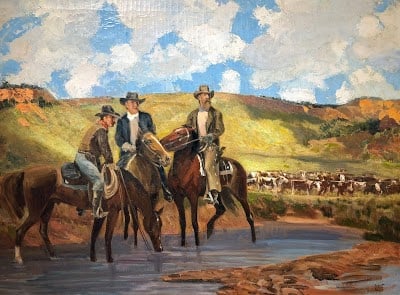
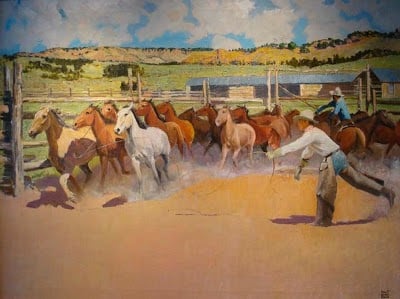
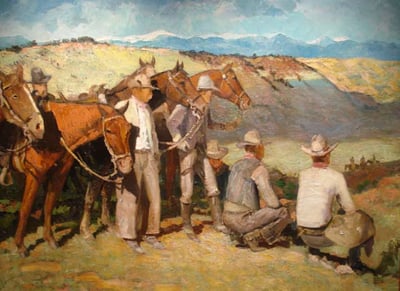
Robert Wesley Amick (1879–1969) was an American painter and illustrator known for scenes of the Old West: stagecoaches, mounted riders, horses on rough terrain, and the Ute and Sioux people of southern Colorado. He was born on October 15, 1879, to a ranching family on Currant Creek, west of Canon City, one of six children, and he spent sixty years painting that country from a studio two thousand miles east of it. The terrain in his canvases is not researched terrain. He grew up on it.
Amick came to painting by way of the law. He began the degree at Pennsylvania in 1900, transferred to Yale, and took art classes on the side. He graduated in 1903 and gave the profession two years in Cleveland before conceding it would not hold him. He reached New York in 1905, studied privately and at the Art Students League until 1909, and was placing illustrations in Metropolitan, Redbook, The American, Scribner's, and Harper's before he had finished there. Membership in the Society of Illustrators followed in 1913. He worked from Washington Square for two decades, kept a summer studio at Woodstock from 1915, and moved the family to Greenwich, Connecticut in 1926, where he started the Art Society of Old Greenwich the following year and led it for the next seventeen.
Amick's western pictures found their audience through a printing press rather than a gallery. Starting in 1921 and running to the end of that decade, the United States Printing and Lithograph Company issued twelve of his canvases as chromolithographs, shipping them to schoolrooms across the country and selling them over the counter besides. Enchanted Pool. The Pioneers. Phantom Canyon. The Indian Weaver. Pueblo Indian. The Great Divide. Where the Sun Goes. For a great many American children those seven images were the frontier, tacked above a blackboard in a town that had never seen a mesa, and behind them was a Colorado boyhood being recalled at a drawing table on Washington Square. His portrait of the racehorse Man o' War reached a public with no particular interest in the West at all.
Amick painted mainly in oil on canvas, with smaller work on board and canvas board and a scattering of watercolors, and he kept at it from about 1909 until his death in Old Greenwich in 1969. The output falls into two halves that match the two halves of his life. There is the remembered country, which is stagecoaches and riders and Native American subjects and canyon walls. Then there is the country outside the window, which is horses, New England woodland, eastern landscape, and the portrait commissions he took on through the 1940s. Both halves carry the same signature, which is why a family can own one and never suspect the other exists. The western canvases are the ones collectors chase.