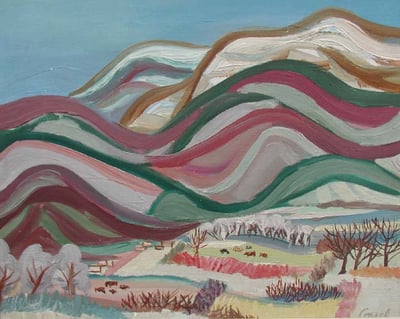
Leo Garel
Leo Garel (1917–1999) is a highly celebrated Taos painter within mid-century Southwestern Expressionism. His explosive, thick-pigment interpretations of the New Mexico landscape famously caught the attention of cultural titan Mabel Dodge Luhan and legendary modern gallerist Alfred Stieglitz, making his robust canvases immensely collectable centerpieces for Western art enthusiasts. Instead of rendering passive regional realism, Garel gained acclaim for hurling jagged mountain ranges and toppling geometric planes directly onto his canvas in bold strokes. This unique ability to merge intense, European-influenced abstract expressionism with the stark vastness of the high desert makes his scarce, mid-century Western paintings highly memorable.
Born in Brooklyn, New York, to immigrant parents, Garel developed an early obsession with drawing before honing his advanced draftsmanship at the Parsons School of Design and the Art Students League under master modernists George Grosz and Vaclav Vytlacil. He initially built a successful national reputation as a prolific commercial illustrator, regularly publishing sharp, whimsical cartoons in The New Yorker and The Saturday Evening Post. However, his artistic direction permanently shifted when he relocated to Taos, New Mexico, from 1945 to 1952. Immersed in the desert sun, he exhibited at iconic early venues like the Blue Door Gallery and Galeria Escondida. Later in life, he returned East to the Berkshire Mountains, where he worked alongside psychoanalyst Erik H. Erikson to pioneer the groundbreaking field of art psychotherapy. Today, Garel’s rare desert abstractions remain pristine, powerful touchstones of the post-war Western avant-garde.