Ralph Meyers
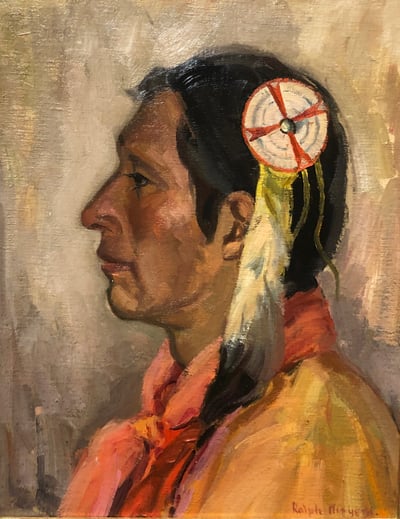
Ralph Waldo Emerson Meyers (1885–1948) is universally revered as the legendary "Taos Renaissance Man" who operated as the indispensable guide, outfitter, and builder for the iconic Taos Society of Artists. His exceedingly rare paintings represent a holy grail for collectors of early Southwestern Modernism. He is famous for being a vital bridge between cultures, serving as the very first white merchant to establish trusted trade with the Taos Pueblo. Uniquely gifted and entirely self-taught, Meyers earned a fierce reputation as one of the finest colorists of his generation, capturing the spiritual intimacy of Indigenous portraiture and the raw, unhurried beauty of the desert landscape with an honesty that left his contemporaries in awe. Because he destroyed many of his own canvases and left behind a limited body of work, his vibrant, light-filled oil paintings are highly coveted, prized gems in private collections.
Raised in Denver, Colorado, Meyers had only a third-grade formal education but possessed an insatiable, adventurous spirit. He permanently relocated to Taos in 1909 to work as a rugged forest fire guard, a role that catalyzed his deep, lifelong immersion into the Pueblo and Hispanic communities. In 1912, he established the historic Mission Shop trading post, which became the beating cultural heart of the burgeoning Taos art colony. A true frontier icon, his fascinating persona was later immortalized as the character Rodolfo Byers in Frank Waters’ classic Southwestern novel, The Man Who Killed the Deer. Today, his visionary legacy stands as a pure, unfiltered testament to the dawn of the American Western avant-garde.