Willard Nash
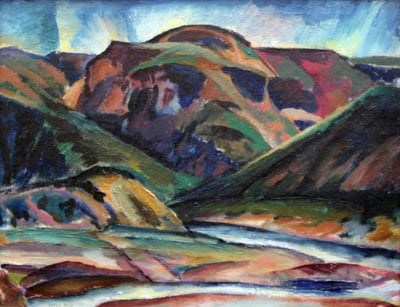
Willard Ayer Nash (1898–1943) is universally celebrated as a revolutionary force in Southwestern art, famously dubbed "the American Cézanne," and as a core member of Los Cinco Pintores (The Five Painters), a legendary group of young iconoclasts who permanently upended the Santa Fe art scene in the 1920s for injecting radical European avant-garde principles into the traditional landscapes of the American frontier. Eschewing literal regional realism, Nash remains immensely collectable for his brilliant, experimental mastery of form and color—seamlessly shifting between Fauvism, Cubism, and fluid abstraction. Because his life was tragically cut short, his vibrant, light-filled oil paintings and rare lithographs are considered highly finite, prized centerpieces in elite private collections worldwide.
Born in Philadelphia, Pennsylvania, and raised in Detroit, Michigan, Nash possessed a diverse range of talents; before dedicating himself to fine art, he studied with John P. Wicker, worked as a successful commercial illustrator at age sixteen, and briefly performed as an actor and amateur boxer. His artistic trajectory transformed forever when he traveled to Taos in 1920 to study under master modernist Andrew Dasburg. Captivated by the unique luminescence of New Mexico, he spent over a decade pushing the boundaries of Western abstraction before spending his final years teaching in California. Today, his visionary canvases stand as a vital, foundational bridge between European Modernism and the American West.